
Deck repair or replacement? Charleston homeowners shouldn't ignore these 12 warning signs
Repair the deck when the rot, rust or looseness is limited to boards, railings or a few framing members. Replace it when the ledger, several joists, the posts or the footings have failed, or when the deck was built without the 6x6 posts, 1,500-pound lateral connectors and ledger flashing that the American Wood Council's DCA 6 guide calls for.
Deck repair or replacement in Charleston comes down to one question: is the framing under your boards still sound? New boards on good joists cost a fraction of a rebuild. New boards on a rotted ledger only hide the problem for another year or two.
Charleston International Airport averages about 52.48 inches of precipitation a year, salt air reaches every screw on a deck at Folly Beach or Isle of Palms, and Formosan termites are most concentrated along this stretch of coast. This checklist walks you through the 12 signs we look for when we inspect a deck, what each one means, and which ones push the job from a repair to a rebuild.
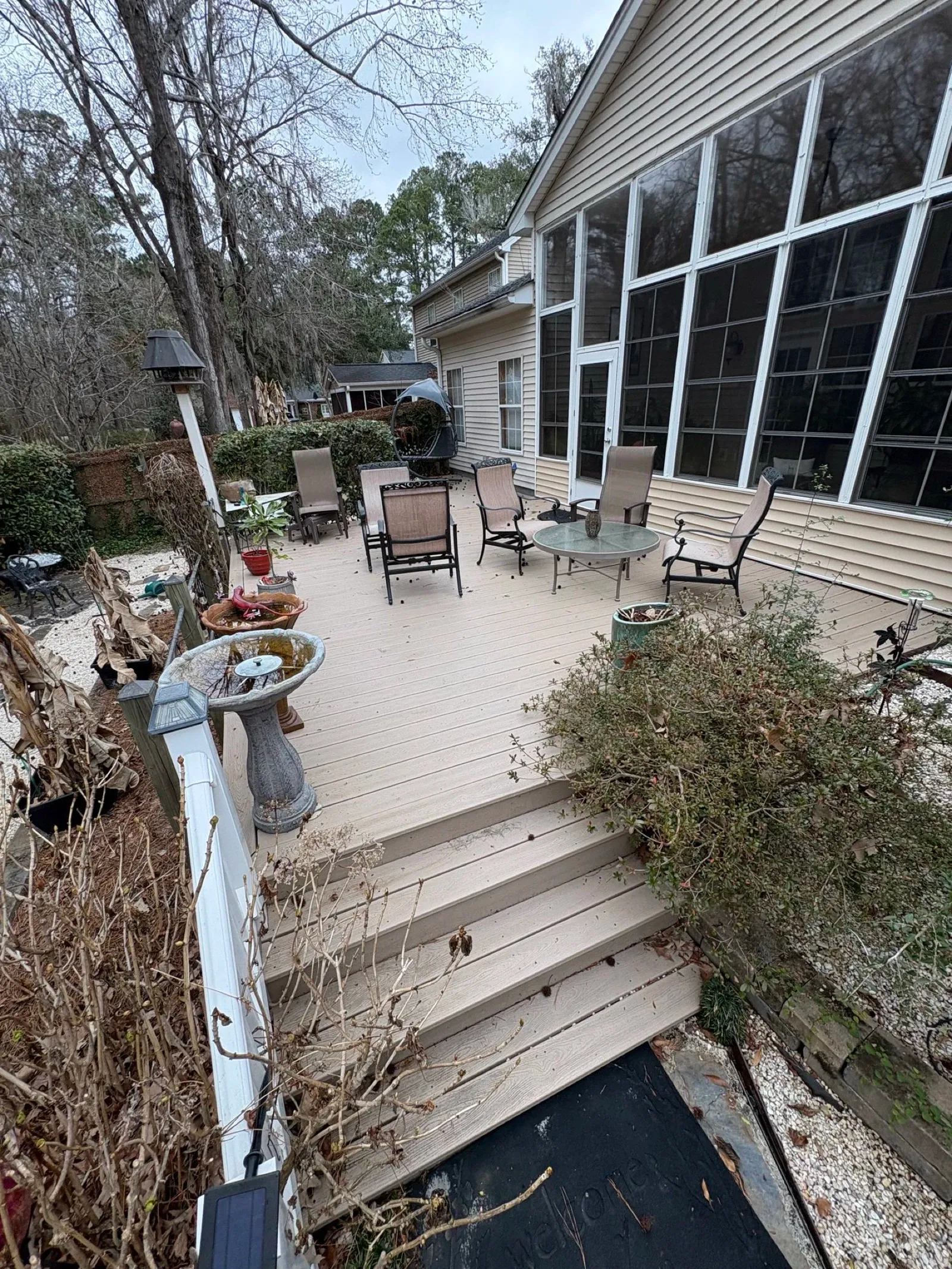
Deck repair or replacement in Charleston: how to make the call
Start under the deck, not on top of it. The boards you walk on are the cheapest part to replace. The ledger (the board bolted to your house), the joists, the beams, the posts and the footings carry the load, and if two or more of those are failing, you're usually looking at a rebuild.
The tools you need for a self-inspection
Grab a flat screwdriver, a flashlight and a level. Push the screwdriver into the wood at each spot on the checklist below. Sound pressure-treated pine resists the tip. Rotted wood lets it sink a quarter inch or more and feels spongy when you pull it out. If you find soft wood at the ledger or posts, have our deck repair crew in Charleston look before you buy any lumber.
Is my deck safe to use right now?
If the deck moves when people walk on it, the railing gives when you lean on it, or the ledger is pulling away from the house, keep everyone off it until someone checks the framing. Board rot and popped nails are trip hazards. Ledger and post failures can drop the whole deck.
Warning signs 1 to 6: the framing and the ledger
These six signs involve the parts that hold the deck up. Two or more usually mean the framing has to come apart.
1. Soft wood at the ledger board
Water runs down the siding and sits on top of the ledger, so it rots first on most Charleston decks. Probe the top edge and around every bolt. If the screwdriver sinks in at more than one spot, a deck ledger board repair means pulling the ledger, checking the house sheathing behind it and installing a new flashed ledger.
2. Rot at joist ends and post bases
Joist ends and post bottoms stay wet longest after a storm. Probe the last few inches of each joist and the lowest foot of each post. One or two soft joists can be sistered (a new joist bolted alongside the old one). Several soft joists usually means new framing.
3. Soft or split stair stringers
Stair stringers (the notched boards that carry the treads) often rest right on soil. Probe where each one meets the ground and at each notch. New stringers are a common repair that leaves the rest of the deck alone.
4. Missing ledger flashing
From a ladder, you should see metal or membrane flashing tucked behind the siding and lapped over the ledger. If the ledger sits against bare siding with nothing over it, water has been getting behind it since the day it was built.
5. Water stains on the siding below the ledger
Dark streaks or peeling paint under the deck mean water is getting behind the ledger. A stain on the wall of the room behind the deck means the leak has reached the house framing. Then it's a deck job plus a wall repair, which our general construction team handles.
6. Posts buried in soil, or 4x4 posts
Many older decks have 4x4 posts set straight into the dirt. Soil holds moisture against the wood, so these posts rot from the inside. DCA 6 specifies minimum 6x6 posts, so plan on new posts and footings even if the 4x4s look fine.
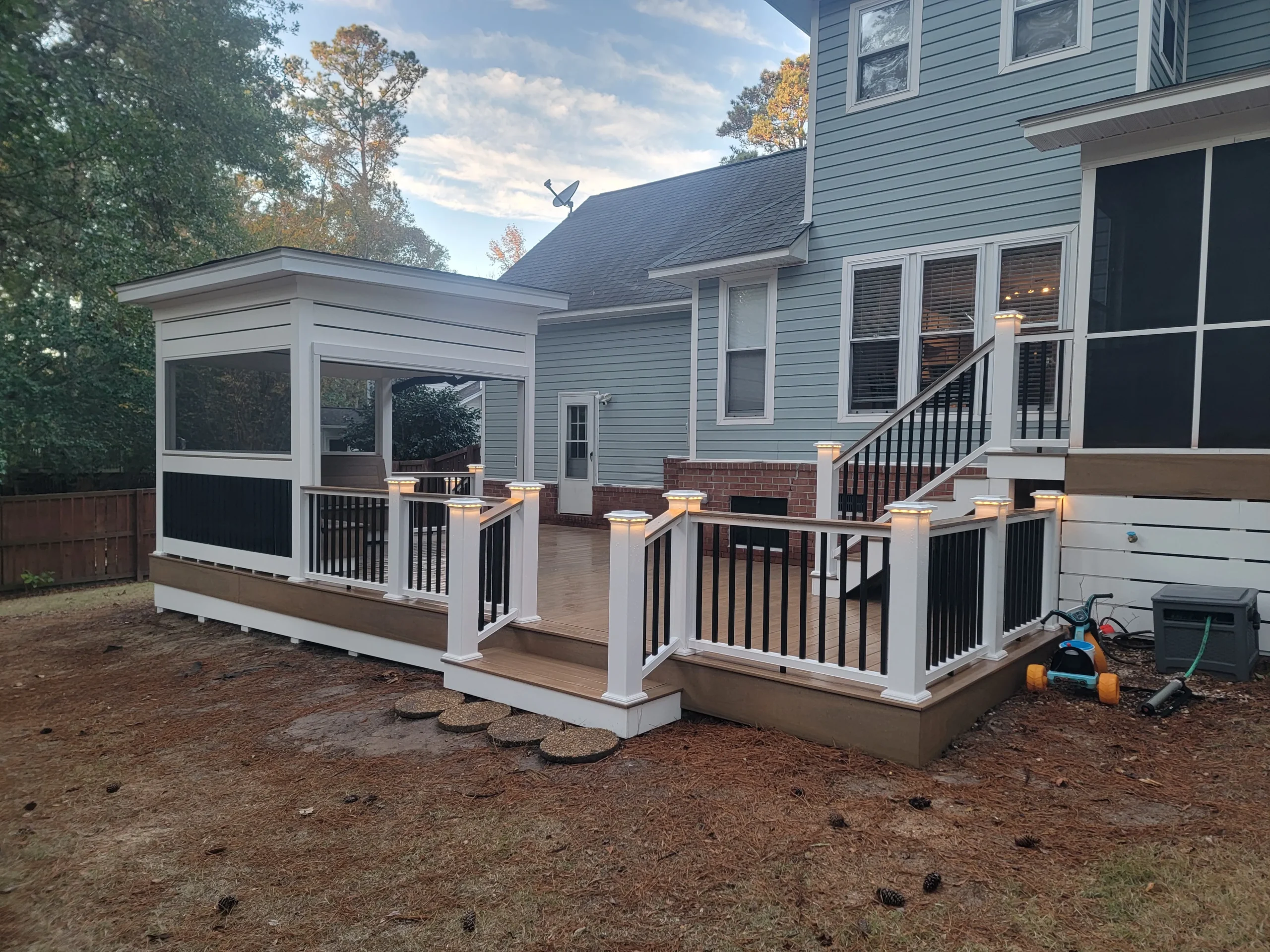
Warning signs 7 to 12: boards, railings, metal and pests
Most of these are repairable on their own. They become a replacement call when they show up alongside the framing problems above.
7. Sagging or bouncy joists
Lay a level across the deck in a few directions. A dip or a bounce points to undersized, overspaced or rotting joists. An added beam or a few sistered joists fix a small sag. A sag across the whole deck means the framing was undersized from the start.
8. Cracked, tilted or sinking footings
Cracks through a footing, a tilted footing or a post that has dropped below its neighbors mean the support has moved. One bad footing can be dug out and poured again. Several usually go with a rebuild.
9. Wobbly or loose railings
Push hard on the top of each railing post. Posts fastened with a couple of nails into the rim joist loosen as the wood shrinks and swells. New through-bolts or blocking fix most of them, unless the rim joist behind is soft.
10. Popped nails and rusted connectors
Popped nails come from years of wet and dry cycles, and re-screwing the boards fixes them. The bigger worry is under the deck: joist hangers, post bases and bolts near salt water rust much faster than inland. On a deck at Folly Beach, Isle of Palms or along the marsh in Mount Pleasant, scrape one hanger. Flaking rust or holes mean every connector needs replacing with coastal-rated hardware.
11. Soft, mildewed boards in shady spots
Boards under a live oak or on the north side of the house stay damp for days after rain. Green or black growth and boards that flex underfoot are the rotted deck boards Charleston yards produce most. Replacing a handful is simple. If the shady half of the deck is soft, probe the joists below first.
12. Termite mud tubes or swarmers
Clemson Cooperative Extension counts eight termite species in South Carolina, four drywood and four subterranean. The Formosan subterranean termite arrived in the 1950s, can be the most destructive and hardest to treat, and is most concentrated in coastal areas from Charleston south to Beaufort. Check posts and stringers for pencil-width mud tubes running up from the soil, and watch for swarmers about 1/2 inch long and golden brown. Call a licensed pest control company first, then have the wood assessed.
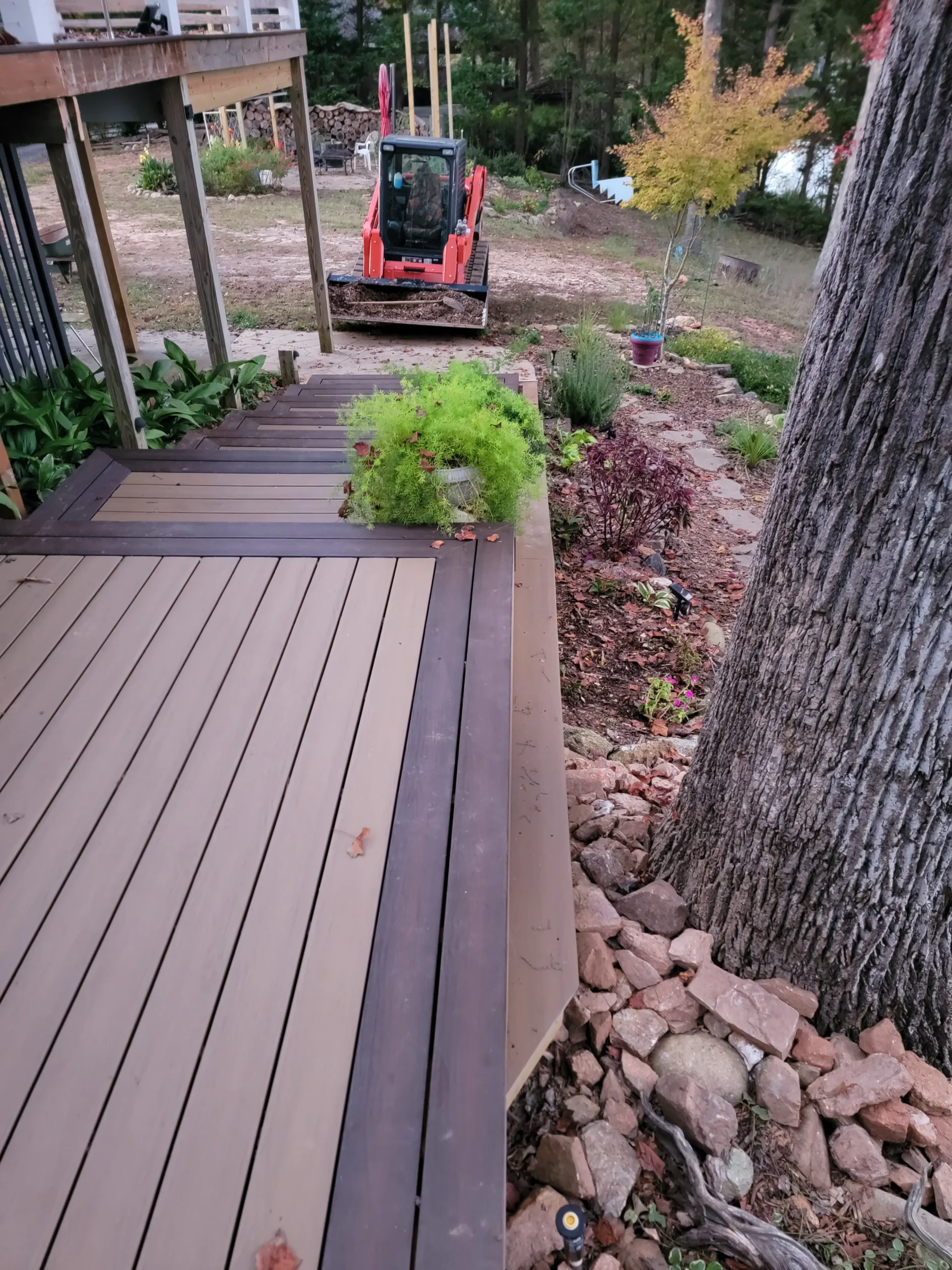
Is it repairable? A quick table
Use this table after your walk-around. Replacement comes up when a problem has spread or sits in the ledger, posts or footings.
| Problem found | Usually repairable? | When it means replacement |
|---|---|---|
| Soft wood at the ledger | Rarely; the ledger has to come off | Rot runs the length of the ledger or into the house sheathing |
| Rotted joist ends | Yes, one or two can be sistered | Several joists are soft, or the rim board is soft too |
| Rot at post bases | Sometimes, with new posts and footings | Most posts are soft, or they're 4x4s set in soil |
| Soft stair stringers | Yes, new stringers are a common repair | Only if the deck framing they attach to is also failing |
| Missing ledger flashing | Yes, if the ledger is still sound | The ledger and sheathing behind it have already rotted |
| Sagging joists | Yes, with an added beam or sistering | The whole frame is undersized or rotted |
| Cracked or sinking footings | Yes, one footing at a time | Several footings have moved |
| Wobbly railings | Yes, with through-bolts and blocking | The rim joist the posts attach to is rotted |
| Rusted connectors | Yes, swap in coastal-rated hardware | Rust has eaten into the wood around the hangers |
| Soft, mildewed boards | Yes, board by board or a full resurface | The joists under the boards are soft too |
| Termite damage | Sometimes, after treatment | Damage reaches posts, beams or the ledger |
Why older Charleston decks often fall short of DCA 6
A deck built 15 or 20 years ago may have passed inspection at the time and still miss today's standards. The American Wood Council's DCA 6 prescriptive deck guide applies to single-level residential wood decks, and several of its details are things older decks around Charleston simply don't have.
Post size
A lot of decks in West Ashley, James Island and Summerville were built on 4x4s. Swapping posts means shoring, new footings and new post bases, which alone can tip a worn deck toward a rebuild.
Lateral load connectors
DCA 6 prescribes 1,500-pound hold-down tension devices to tie the deck framing back to the house, so the deck can't pull away from the wall. Most older decks have none. They can often be added if the house framing and joists are sound.
Ledger attachment and brick veneer
DCA 6 sets out how the ledger is fastened and flashed, and it doesn't allow a ledger on brick veneer, which is a facing, not structure. If your deck is bolted through brick on a home in Goose Creek or North Charleston, the fix is a freestanding deck with its own beam and posts along the house, priced like a rebuild.
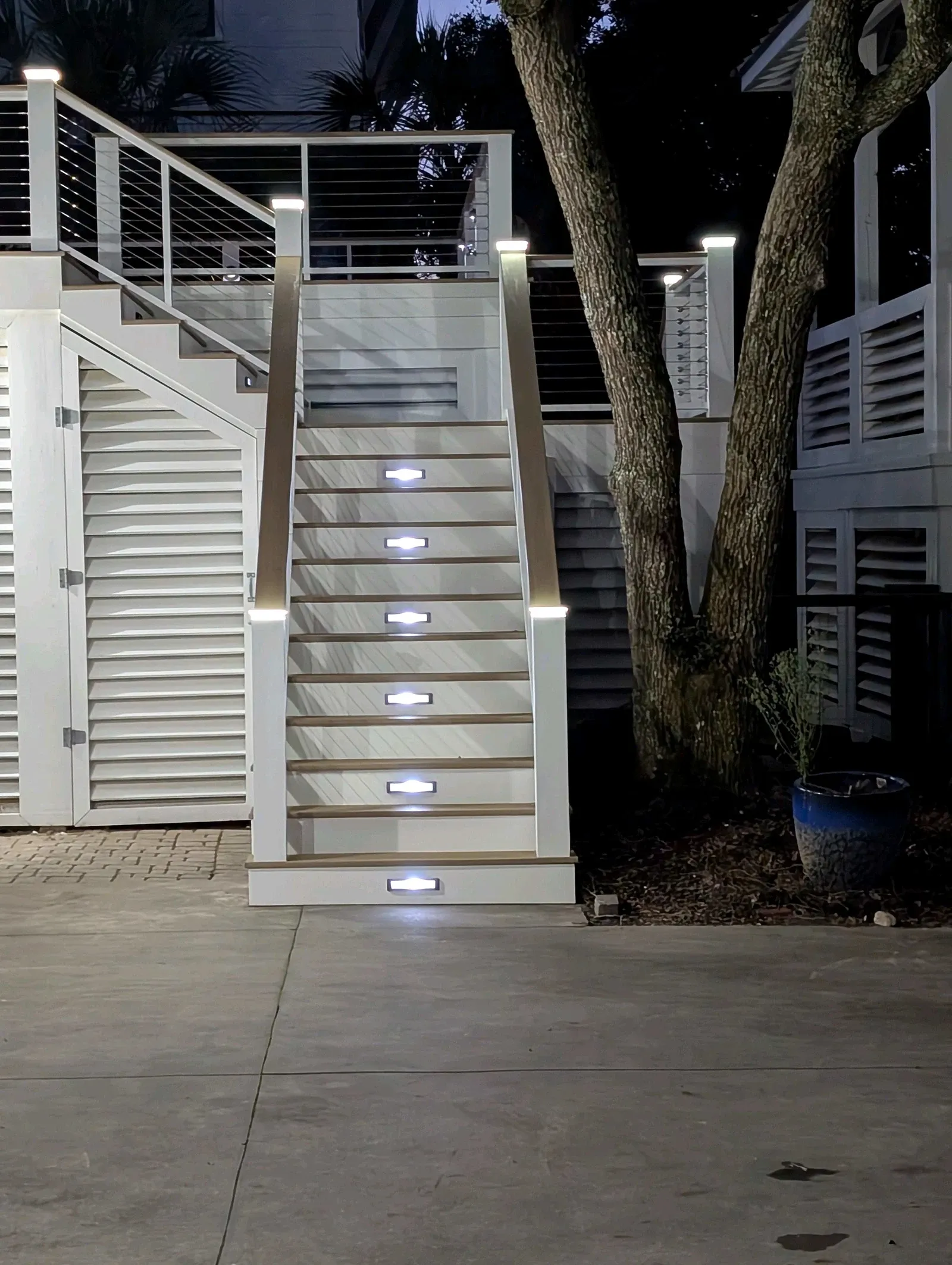
Resurfacing vs a full rebuild, and what each costs
Resurfacing means new boards, and often new railings and stairs, on framing that passed the probe test. A rebuild means tearing the deck down to the footings. The price gap is why the inspection comes before the quote.
When resurfacing makes sense
If the ledger is solid and flashed, the joists are firm, the posts are 6x6 and the footings haven't moved, new boards are the right call. It's also the cheapest way to switch to composite decking, if the joist spacing suits the board you pick. Ask for new joist tape while the old boards are off.
When a rebuild makes sense
Rebuild when the ledger has rotted, several joists or posts are soft, the deck sits on 4x4s or the ledger is bolted to brick. Patching all of that costs more labor than framing new. Our deck replacement team in Charleston tears down, permits and frames a new deck to current details.
How repair costs add up
Repair pricing follows what has to come apart. Boards and railings come off quickly. Joists, the ledger and posts sit under everything else, so replacing them means removing boards, shoring the deck and putting it back. Most quotes leave out a line for hidden rot found once the boards are off; ask how it's priced before work starts.
What a new deck costs for comparison
The 2025 Cost vs Value report puts a sample wood deck addition at $18,263 nationally, with $17,323 recouped at resale (94.9%). A composite deck addition in the same report runs $25,096. For the South Atlantic region, the wood deck comes in at $18,397 and the composite deck at $24,347. These figures describe one defined sample project, not your deck, but they make a ceiling for weighing a repair quote. Our post on deck building cost in Charleston breaks down wood vs composite pricing in more detail.
Should you upgrade while you're at it?
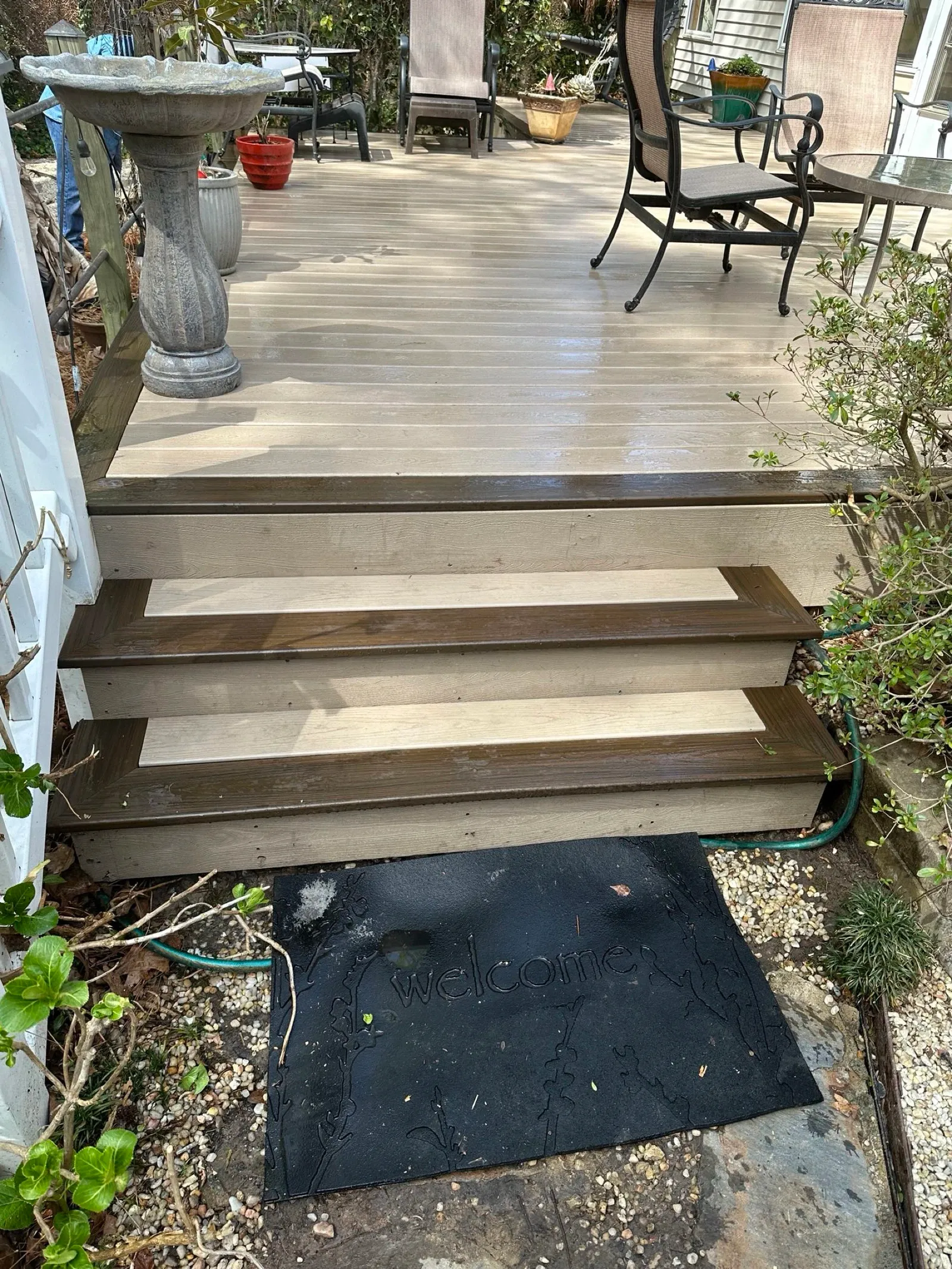
A rebuild is the cheapest time to change the deck's size or plan for a cover. A roof over the deck changes post and footing sizes, so read our comparison of sunrooms, pergolas and screened porches in Charleston first. For a new layout, our deck installation service starts with a site visit.
Do I need a permit to repair a deck in Charleston?
Board replacement on sound framing usually doesn't need one. Structural work (joists, ledger, posts, footings, stairs or a rebuild) usually does. Who issues the permit depends on where the house sits: the City of Charleston, North Charleston, Mount Pleasant, Summerville, Goose Creek, or the county for unincorporated areas.
The City of Charleston deck package
The City of Charleston publishes a Residential Deck Detail Package based on the South Carolina residential building code. It shows the framing and connection details inspectors look for. Check with your town or county building department for fees and inspection steps.
Outside the city
In Moncks Corner, Hanahan and the rest of Berkeley County, and in Summerville, St. George and the rest of Dorchester County, the same rule holds: structural deck work goes through the local building department. Once you approve a plan, we handle the permit paperwork as part of the job.
A Lowcountry deck maintenance schedule
Most rot on this list starts with water that sat too long. A seasonal routine catches it before it reaches the framing.
Spring
- Wash the boards with a deck cleaner and a soft brush to clear mildew and pollen.
- Check posts and stringers for termite mud tubes, and watch for swarmers.
Summer
- Trim shrubs and branches back from the deck so boards dry after storms.
- Watch the siding under the ledger after heavy rain; August is the wettest month at about 7.0 inches.
Fall, after hurricane season
- Run the full 12-sign checklist above, with the screwdriver probe at the ledger, joist ends, post bases and stair stringers.
- Stain or seal wood decks on a dry stretch of weather, once the boards have dried out.
On the barrier islands, rinse salt off railings and hardware each year. Our Folly Beach exterior remodeling and Isle of Palms exterior work pages cover the materials we use for salt exposure.
What homeowners say about working with us
Deck repairs happen right against your siding and doors, so surface protection and daily cleanup matter.
"I've had both interior and exterior projects completed by Ace Custom Exteriors. They are fabulous to work with, attentive to details, take great care in protecting your surfaces and clean up after themselves."
Lori Miller, Google review
Frequently asked questions
How do I know if my deck is safe?
Push on the railings, walk the deck and look under it. If the deck moves, the railing gives, the ledger is pulling away from the house or the screwdriver sinks into the ledger or posts, keep people off it until a contractor checks the framing. Soft boards alone are a trip hazard, not a collapse risk.
Can I just replace the deck boards?
Yes, if the framing passes the probe test. The ledger has to be solid and flashed, the joists firm, the posts 6x6 and the footings level. New boards on rotted joists will need to come up again within a few years, so check the framing first and replace any soft joists while the boards are off.
What does a deck ledger board repair involve?
The boards near the house come up, the deck is shored, and the old ledger comes off. The house sheathing behind it gets checked and repaired if it's wet or soft. A new ledger goes on with proper fasteners and flashing tucked behind the siding, then the joists are re-hung and the boards go back down.
Do I need a permit to fix my deck?
Replacing boards on sound framing usually doesn't need one. Replacing joists, the ledger, posts, footings or stairs usually does. The permit comes from your town or county: the City of Charleston, North Charleston, Mount Pleasant, Summerville, Goose Creek or the county. Check with that building department before work starts.
Do you do deck repair in Summerville?
Yes. American Custom Exteriors is based at 207 Pinewood Dr in Summerville and works across Charleston, Berkeley and Dorchester counties. Call 843-518-9923 for a free on-site consultation and estimate. We're open Monday through Saturday from 7:00 AM.
Get your deck checked before the next storm season
American Custom Exteriors is a family-owned exterior remodeler based in Summerville, founded in 2021 by JR Bankson, with a team that brings 40+ years of exterior remodeling experience. We'll probe the ledger, posts and joists and tell you whether repair or replacement makes sense.
Call 843-518-9923Request a free estimateSources
- American Wood Council, DCA 6 Prescriptive Residential Wood Deck Construction Guide
- Clemson Cooperative Extension, Formosan Termites Increase Distribution in SC
- Journal of Light Construction, Cost vs Value 2025 National Data
- Journal of Light Construction, Cost vs Value 2025 Charleston, SC and South Atlantic
- City of Charleston, Residential Deck Detail Package
- Extreme Weather Watch, Charleston SC Average Rainfall by Month (NOAA 1991-2020 normals)
