Metal roof vs shingles in Charleston: which holds up better on the coast?
On an average 2,662 sq ft Charleston roof, asphalt shingles run about $17,889 and metal about $36,348. Shingles cost about half as much and recoup more at resale. Standing seam metal earns its price on the barrier islands and on homes you plan to keep for decades. In a hurricane, the way the roof deck is fastened and sealed matters more than the covering on top.
The metal roof vs shingles Charleston question comes down to how close you live to salt water, how long you'll own the house, and your budget. A Summerville ranch and a raised house on Sullivan's Island don't face the same air.
How much more does a metal roof cost in Charleston?
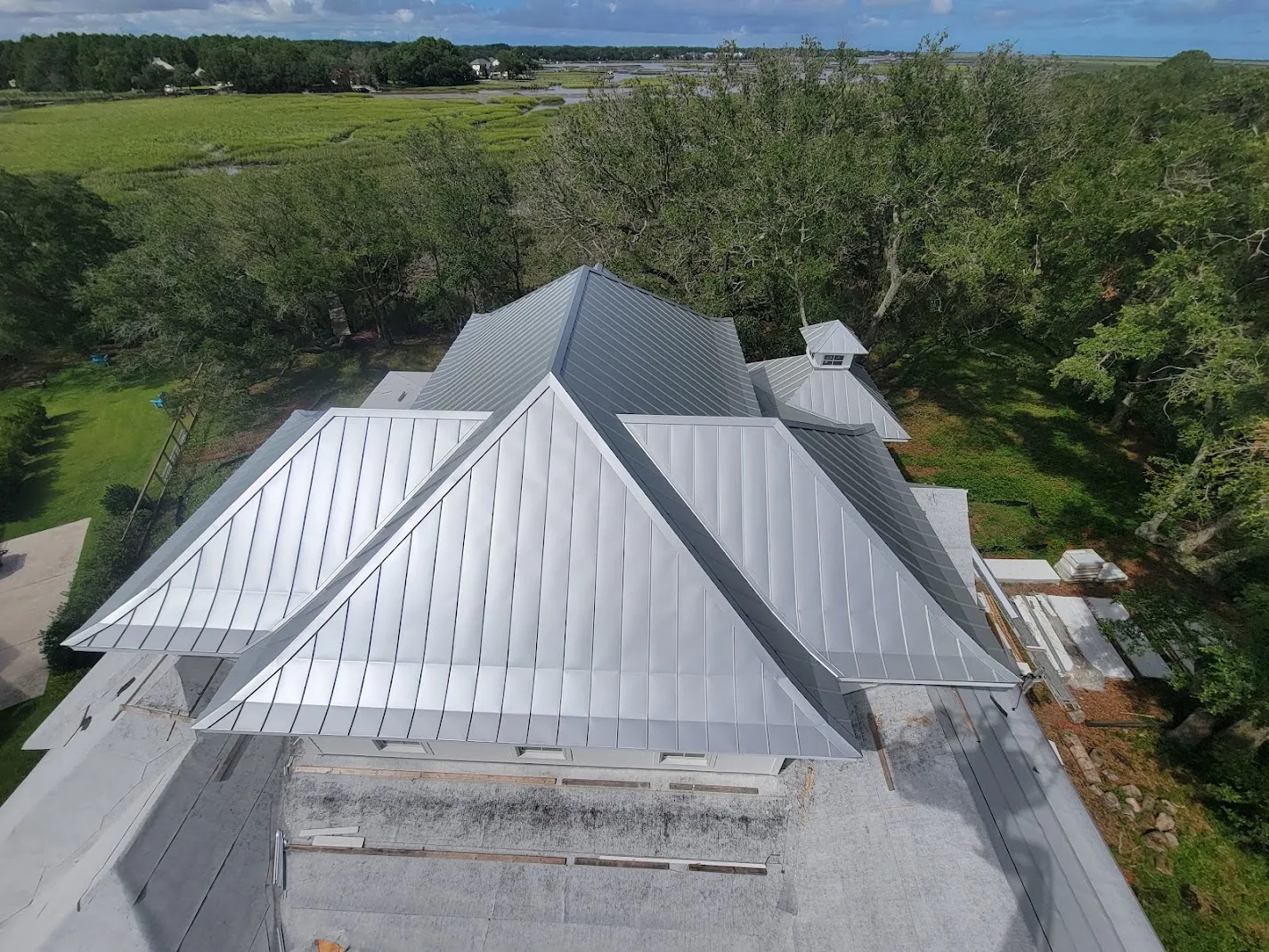
Metal costs roughly twice as much as asphalt on the same Charleston roof. Instant Roofer's Charleston cost page puts an average asphalt shingle replacement at about $17,889, based on a 2,662 sq ft roof (26.67 squares) at about $6.72 per sq ft, or $672 per square. Metal on that same roof comes in around $36,348, a gap of $18,459.
What the national resale numbers say
The Cost vs Value 2025 national report prices a defined sample roofing project, not your house. In that sample, an asphalt shingle replacement costs $31,871 and adds $21,501 in resale value, so 67.5% comes back when you sell. A metal replacement costs $51,865 and adds $25,972, which is 50.1% recouped.
Metal adds more resale dollars, but you pay far more to get them, so the percentage drops.
What moves a roof quote up or down
Roofs are priced by the square (100 sq ft). After size, the quote moves with pitch, valleys, layers to tear off and rotted decking. Most quotes leave out the decking replacement line or bury it as an allowance; ask what they charge per sheet before you sign.
Metal quotes also move with panel type, gauge and trim. For a line-by-line look at shingle pricing, our Charleston roof replacement cost guide breaks down each part of a quote.
Side-by-side comparison
| Factor | Architectural shingles | Standing seam metal |
|---|---|---|
| Cost on an average Charleston roof (2,662 sq ft) | About $17,889 | About $36,348 |
| Resale recouped (CvV 2025 national sample) | 67.5% | 50.1% |
| Look | Textured, matches most subdivision homes | Clean vertical lines, common on coastal and farmhouse styles |
| Wind attachment | Nail pattern and sealant strips on wind-rated shingles | Concealed clips fastened to the deck |
| Salt air | No rust; granules and sealant age in sun | Aluminum resists salt; steel coatings need care at cut edges |
| Repairs | Easy to patch; color match can be off | Damaged panel gets replaced; fewer crews do it well |
| Insurance and grant eligibility | Depends on deck attachment and water barrier | Depends on deck attachment and water barrier |
Standing seam vs exposed-fastener metal: which kind are you being quoted?
A standing seam metal roof in Charleston SC uses panels joined at raised seams and held to the deck with hidden clips, so no screw goes through the face of the roof. Exposed-fastener panels are screwed straight through the metal with rubber-washer screws. The second kind costs less, and it's the one most likely to leak later.

Why the fastener matters in the Lowcountry
Metal grows and shrinks with every hot afternoon and cool night. On an exposed-fastener roof, that movement works the screws in their holes while the rubber washers dry out in the sun. After enough summers, screws loosen and water follows them in.
Standing seam clips let the panel slide as it expands, so the metal moves without tearing at a screw hole. The seams sit above the flat of the panel, where water runs past them.
When exposed-fastener panels make sense
Exposed-fastener panels fit sheds and barns, where an occasional drip doesn't ruin drywall. On a house, if the budget only reaches exposed-fastener metal, we'd point you to good architectural shingles instead.
Metal roof salt air: what changes on Folly Beach, Sullivan's Island and the other islands
Salt spray eats steel faster than it eats aluminum. On the barrier islands (Folly Beach, Sullivan's Island, Isle of Palms, Kiawah and Seabrook), the metal choice matters as much as the metal versus shingle choice. Inland in Goose Creek or Summerville, coated steel holds up fine with normal care.
Aluminum vs galvanized and Galvalume steel
Aluminum panels don't rust the way steel does, which is why roofers use them on houses facing the surf. Galvanized and Galvalume steel rely on a metal coating over the steel. That coating works well across most of the Charleston area, but salt sitting on cut edges and scratches can start corrosion where the coating is broken.
Before you sign for steel on an island home, ask for the panel warranty in writing and read what it says about salt exposure and distance from the water. If the answer is unclear, price aluminum too. For houses on Folly Beach or Sullivan's Island, that second quote is worth the phone call.
Fasteners, flashing and trim count too
Steel screws or flashing touching aluminum panels can set off galvanic corrosion around each contact point. Every clip, screw and piece of flashing should match or be rated to sit against the panel metal.
Shingles don't rust, which is one reason plenty of homes on Isle of Palms and Kiawah Island still wear asphalt. Their metal parts still face salt, though. Drip edge, step flashing and pipe boots on a shingle roof should be aluminum or another salt-tolerant metal, not bare steel.
Which roof does better in a hurricane?
Both can ride out a coastal storm, and both can fail in one. What decides it is the attachment system underneath: how the roof deck is nailed to the rafters, whether the deck seams are sealed, and whether there's a secondary water barrier. The Post and Courier's report on storm-resistant homes lists those same items as what makes a Safe Home-standard roof.
The parts of the roof you never see
According to the Post and Courier, a Safe Home-standard roof includes stronger sheathing attachment, a secondary water barrier, gable bracing and wind-rated shingles. When a storm peels off the covering, the sealed deck and water barrier keep rain out.
A cheap metal roof over loosely nailed decking is a worse bet than a shingle roof over a re-nailed, sealed deck. Ask every contractor how they'll fasten the deck. If the answer is "same as the old roof," keep looking.
Architectural shingles in a hurricane
Architectural shingles are thicker than old 3-tab shingles and come in wind-rated lines. Their hold depends on the nail count, where the nails land, and whether the sealant strips bond. Starter strips at the eaves and rakes matter most, because wind lifts the edges first.
Hip vs gable
Roof shape counts as much as roofing material. The Post and Courier reports that hip roofs are more wind-resistant than gable roofs and usually cost less to insure. If you have a gable roof, gable-end bracing is part of the Safe Home standard, and a reroof with the attic open is the cheapest time to add it.
Design wind speeds run high inland too
Coastal wind rules don't stop at the bridges. The City of Goose Creek's wind-borne debris requirements note that the SC Building Codes Council wind maps put the city in a zone with ultimate design wind speeds of 140-145 mph. That rule covers windows and glass doors, but it shows how hard roofs well inland are expected to hold.
Insurance discounts and SC Safe Home grants
Neither material earns a discount on its own. South Carolina law requires insurers to give discounts for storm mitigation, and the Post and Courier reports some features can cut hurricane premiums 10% or more, though each company sets its own discounts. The mitigation is the deck attachment, water barrier and bracing, which you can get with metal or shingles.
How SC Safe Home works
SC Safe Home is the state's wind-mitigation grant program, run by the SC Department of Insurance and created in 2007. It's for owner-occupied single-family homes in designated coastal counties, and Charleston County is one of them. If you live in Berkeley or Dorchester County, check the program site for your address before you count on a grant.
The award tiers are tied to the roof retrofit standard, not to one roof covering:
- Resilient Mitigation Award, for roof retrofits that meet SC Safe Home and IBHS FORTIFIED Roof guidelines: up to $7,500 non-matching or $6,000 matching.
- Sustainable Mitigation Award, for roof retrofits that meet SC Safe Home guidelines only, or for window and door opening protection: up to $5,000 non-matching or $4,000 matching.
- Hurricane shutters and protective barriers: up to $3,000.
The program opened new application rounds in 2026, starting February 10. Money is limited and windows open and close, so check the site before you schedule work. The roof needs local permits and inspections plus a program inspection, the work has to go through a contractor on the program's participating list, and grants can't pay for general repairs. Ask your contractor whether they're on that list.
Homeowners who retrofit through the program have reported savings of up to 24% on annual property insurance premiums, according to Brookings.
Heat, rain noise and repairs
Metal reflects more sun than dark shingles, and lighter metal colors help keep attic temperatures down in a Charleston August. Rain noise is mostly a myth on houses, because the panels sit on solid decking and underlayment. Repairs are where shingles win: they're cheaper and easier to patch after a storm.

Attic heat
Dark asphalt soaks up sun and passes that heat into the attic. A light-colored metal roof sends more of it back. On both, a ridge vent with clear soffit intake moves hot air out.
Is a metal roof loud in the rain?
The loud metal roofs people remember are on barns, where panels sit on open wood strips. On a house, standing seam goes over plywood or OSB decking and underlayment, with the attic and insulation below.
Fixing leaks on each roof
A shingle roof that loses a few tabs in a storm can usually be patched in an afternoon, though new shingles may not match faded ones. Shingle leaks most often start at flashing, pipe boots and valleys.
Metal leaks are rarer and harder to fix. A dented panel gets replaced, sometimes from ridge to eave, and fewer crews handle that well. Scratches on coated steel need touch-up paint before rust starts.
"American Custom Exteriors has been used in the past for several smaller roof repair jobs with excellent quality. When the time came for replacement of the entire roof there was no question that ACE would be selected."
Anne Hantske, Google review
HOA rules and the historic district
Many neighborhoods in Mount Pleasant, Summerville and on Kiawah have HOA covenants that control roof color and material, and the City of Charleston's Board of Architectural Review covers most of the peninsula. Get approval in writing before you sign a roofing contract.
HOA covenants
Some HOAs list approved shingle colors; others limit metal or ban it. Pull your covenants before the estimate, because a roof the HOA rejects can mean fines or a tear-off. In Mount Pleasant subdivisions, matching the street usually means architectural shingles in a shade the board has already approved.
The Board of Architectural Review
The Preservation Society of Charleston notes that the City of Charleston Board of Architectural Review was established in 1931, that most properties on the peninsula fall under its review, and that roofing is one of the character-defining materials it reviews. If your house is in that area, a change of roofing material goes to the BAR first.

If you're replacing siding too, choose both together. Our guide to the best siding for Charleston homes covers which siding materials hold up in salt air and humidity.
Which roof should you pick? The best roof for coastal South Carolina depends on these answers
Pick architectural shingles if you'll sell soon, have a firm budget, or live where every neighbor has shingles. Pick standing seam metal if this is your forever home, you're on a barrier island, or you have low-slope porch roofs. Either way, pay for the deck attachment and water barrier first.
When shingles are the smarter money
If you'll list the house in two or three years, the Cost vs Value numbers favor shingles: 67.5% recouped against 50.1% for metal. Buyers rarely pay the full $18,459 metal premium. On a tight budget, the money saved can pay for re-nailing the deck and a full water barrier.
In a West Ashley or Summerville subdivision where every house has architectural shingles, metal can look out of place to buyers.
When metal makes sense
Metal pays off when you'll own the house long enough to skip a shingle replacement or two. On the islands, aluminum standing seam handles salt well. Metal also suits low-slope porch roofs, since shingles need a minimum pitch to shed water.

Decision checklist
- Write down how many years you expect to stay in the house.
- Measure your distance to salt water; on an island, price aluminum as well as steel.
- Check your HOA covenants and whether your home falls under the BAR.
- Ask each roofer how they'll fasten the deck and what water barrier goes under the roof.
- Ask whether they're on the SC Safe Home participating contractor list.
- Call your insurance agent and ask which mitigation features earn a discount.
- Get the decking replacement price per sheet on paper.
Once you've picked, the work itself is quick. Most residential roof replacements in the Charleston area take one to three days, depending on size, material and weather. For a new home or addition, see our roof installation page, and browse finished jobs in our project gallery.
Frequently asked questions
Is a metal roof worth it in Charleston?
It's worth it if you'll keep the house for decades or live on a barrier island. On an average 2,662 sq ft Charleston roof, metal costs about $36,348 against $17,889 for asphalt shingles. If you'll sell within a few years, shingles return more: 67.5% of cost recouped nationally versus 50.1% for metal in the 2025 Cost vs Value sample.
Does salt air ruin metal roofs on the islands?
Salt air attacks steel faster than aluminum. Galvanized and Galvalume coatings protect steel well inland, but on Folly Beach, Sullivan's Island, Isle of Palms, Kiawah and Seabrook, salt can start corrosion at cut edges and scratches. Aluminum panels with matching fasteners and flashing are the safer pick near the surf. Read the warranty's salt exposure terms before you sign.
Are architectural shingles good in a hurricane?
Wind-rated architectural shingles hold well when they're nailed correctly and the sealant strips bond. What keeps water out after a storm is underneath: a well-fastened roof deck, sealed deck seams and a secondary water barrier. The Post and Courier lists those items, plus gable bracing, as part of a Safe Home-standard roof.
Can I get an SC Safe Home grant for a metal roof?
The grant tiers are tied to the roof retrofit standard, not to the covering. A roof meeting SC Safe Home and FORTIFIED Roof guidelines can qualify for up to $7,500 non-matching. The home must be owner-occupied in a designated coastal county such as Charleston County, and a contractor on the program's participating list must do the work.
Is a metal roof loud when it rains?
On a house, usually not. The noisy metal roofs are on barns where panels sit on open wood strips. A residential standing seam roof goes over solid decking and underlayment, with the attic and insulation between the roof and the rooms below. Most owners hear about the same rain sound they heard with shingles.
Do I need approval to put a metal roof on a peninsula house?
Most properties on the Charleston peninsula fall under the Board of Architectural Review, established in 1931, and roofing is one of the materials it reviews. A change in roofing material or profile goes to the BAR before work starts. Outside the peninsula, check your HOA covenants, since many limit roof material and color.
Get both roofs priced on your house
American Custom Exteriors gives free on-site consultations and estimates across Charleston, Berkeley and Dorchester counties. We'll measure your roof, check the decking and price architectural shingles and metal side by side, with material, timeline and pricing approved before work starts. Call Monday through Saturday from 7:00 AM.
Call 843-518-9923Request a free estimateSources
- Instant Roofer, Charleston roof replacement cost
- Journal of Light Construction, Cost vs Value 2025 national report
- Post and Courier, Some features make coastal SC homes storm-resistant and less costly to insure
- City of Goose Creek, Wind-borne debris protection requirements
- SC Department of Insurance, SC Safe Home
- Brookings, What incentives are states offering to make houses less vulnerable to extreme weather damage?
- Preservation Society of Charleston, Board of Architectural Review
